The Great Depression
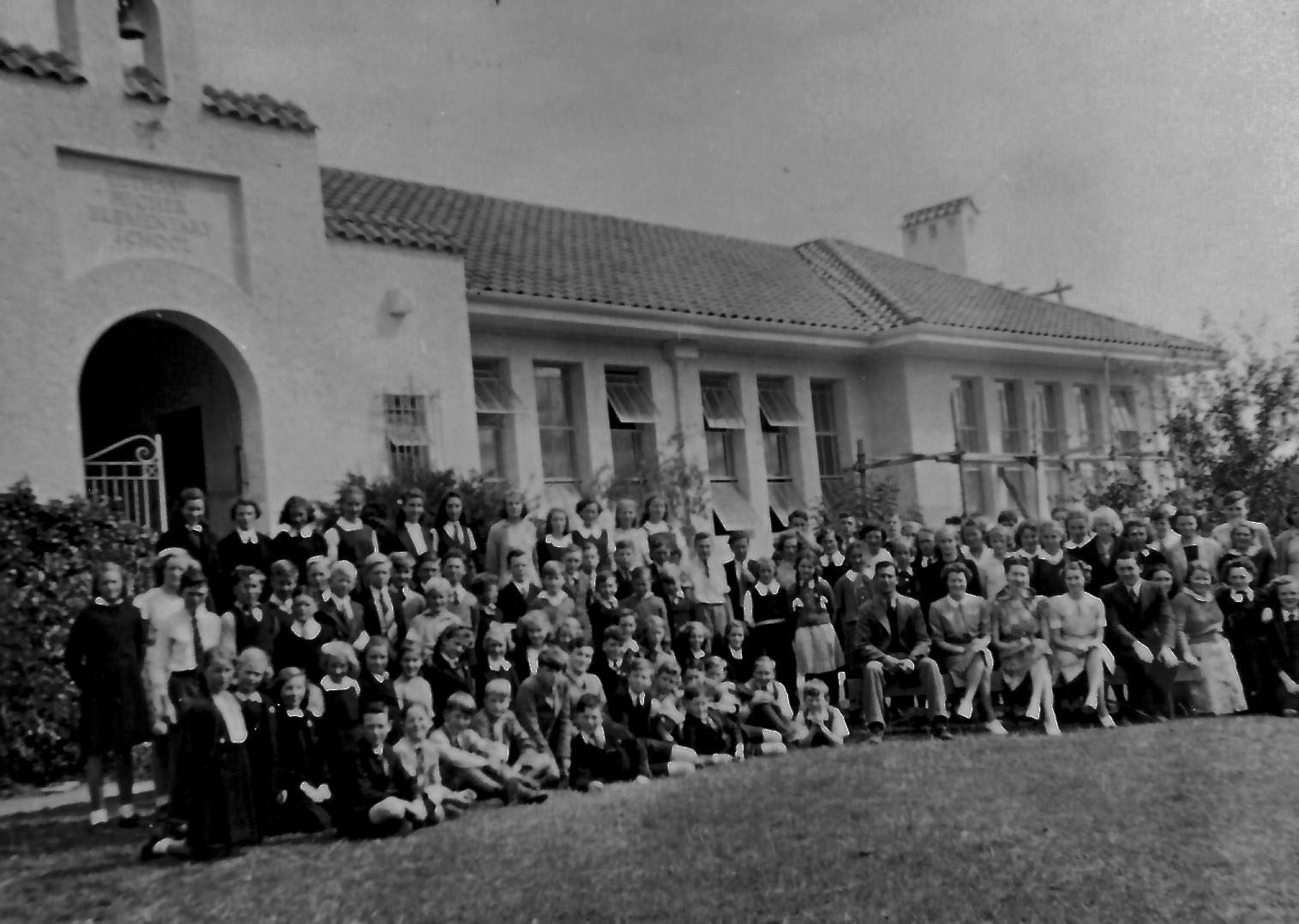
The economic hardships cast their influence over the school.
Unable to financially support their children's schooling, many
students were forced to finish their education at Grade 6.
With this came a sharp decline in enrolments as the school
population fell from 92 students in 1930 to 66 in 1935. This
prompted the "Board of Inquiry Regarding the Administration
of the Education Department" to question the very existence
of Eltham Higher Elementary School.
Bob Finlay, a student at the school between 1934-35 remembers
its effects well.
"At the time, students had no money to spend, some even had no
shoes to wear. Many of the students, no longer able to be
supported by their parents, were made wards of the state."
Fun to be had in hard times
"A rural area, money is scarce. A bike, well we could
share one between six of us, if our mate's were willing to
lend us the only bike at the school. In these times,
students had to make, rather than buy, their fun."
Ex students Bob Finlay and Ray Wood (1936-38) recall
with delight the frequent fruit fights fuelled from
the quince orchard on the northern boundary of the
school as well as the abundant cherry plum trees.
They also remember summers of snake catching, when the boys
would often leave dead snakes across footpaths, especially
where it was known that teachers used those paths to go home.
Speech Nights
These were seen as an important part of the school year
by Mr. Stewart and became established as a school tradition.
Held in a hall in Eltham, these evenings saw the presentation
of academic and sporting prizes; house captains, form
captains and prefects were given recognition of their duty;
the Rutter-Stewart rivalry was resolved by the
announcement of a winner and students would sing "The Best
School of All" with gusto.
Stewart vs Rutter
At the time, students were divided into two houses, Stewart and Rutter.
Sporting competitions in Netball, Rounders, Tennis, Cricket
and Football were keenly fought affairs, held during the
afternoon once a week.
The sporting highlight of 1934 as recalled by Mr. Max Spence, was
the swimming sports. These were held in the Diamond Creek
downstream from the footbridge.
Floods
In times of heavy rain, the footbridge across Diamond
Creek would be cut by flood waters and school would be
cancelled, sometimes for days.
Advisory Council
At a time when student and parent involvement in schools was minimal,
Eltham Higher Elementary displayed a progressive approach by
encouraging the involvement of students and parents.
Mr. Spence believed that Eltham was one, if not the first,
secondary school to have Student, Mothers Club, Parent and
Teacher representatives on the advisory council. As he recalls,
the advisory council was a purely appointed body of:
- Principal - Secretary
- Council rep. from Eltham and Diamond Valley
- Mothers Club rep.
- 1-2 Teacher reps.
- 3 nominated from community
- Church rep.
The Tree Planting Programme
Much work was done in this period in developing
the school grounds themselves. Extensive tree
planting was undertaken firstly by Mr. H. Rutter
and his friend Mr. Allan, Landscape Gardener
to the Victorian Railways and then under the
guidance of Mr. Frederick Grassick, an Eltham resident.
Mr. Grassick devoted much of his spare time
and a considerable amount of money to the
project. In all, Mr. Grassick planted 167
trees, 65 shrubs, a number of climbing roses
and vines, as well as providing a variety of
landscape materials and gardening implements.
As quoted from the Advertiser, Friday, July 28, 1933:
"Planting in the school grounds
has been progressing over the past three years and is now nearing completion.
Close on 300 choice shrubs and trees have been employed in the layout,
and these are making satisfactory growth. The list includes: eucalyptus,
wattles, firs, cedars, cypresses, poplars, oaks, birches, ash trees, chestnuts,
lindens, liquid ambers, tulip trees, maples, flowering fruit trees, and
in addition other small shrub trees. About 400 daffodil bulbs were planted
in the grasses among the young trees and these give promise of flowering
next month."
Detentions lend support to Planting Programme
In 1934, as Bob Finlay recollects, detentions were given
for being late, being noisy in class, not paying attention
and having dirty or undone boots!
Detention time was put to good use, as students were
seen rolling 44 gallon drums full of water around the
school in order to water the trees.
|