The Seventies
The seventies were years of great social and political change, and this was
reflected in the importance of wider issues at school and the rapid changes within
school life.
As the seventies began, Australian soldiers were in Vietnam. The major Moratorium in
1971 became an important issue, involving many EHS students. It also emerged in the
creative work of the students; through their prose and painting. The school
"adopted" a young Vietnamese child through one of the international aid programmes.
The school had over 1000 students in the early seventies and faced severe accommodation
problems, despites the Science wing becoming available at the start of the decade. Portable
classrooms were never loved, but when in 1972 the Education Department attempted to
remove them despite the chronic shortage of classroom space facing the school, the
students responded by welding the two halves together, stringing barbed wire
and arranging seats around the classroom. After some heated confrontation, the
classrooms stayed.
During the early seventies, compulsorys school uniforms disappeared, and long hair
was tolerated after a considerable battle. The traditional school "social" also faded
away. Changes in the curriculum also occurred; "Science" became "Environmental Science",
and "English" became "Communications". This was followed by the introduction of
"Middle School", a vertical streaming of Years 9 and 10.
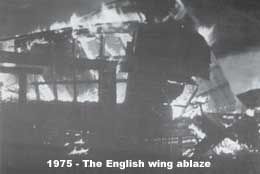
The mid-seventies was an era in which school fires were fashionable, and EHS suffered
the devastating loss of the entire English Department wing in 1975. Many fundraising
activities were organised to try to replace more than $20,000 worth of books and equipment.
Work on a replacement English Department was commenced very rapidly, but it did not become
available until 1977.
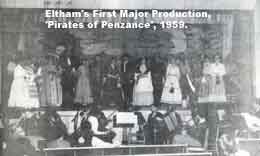
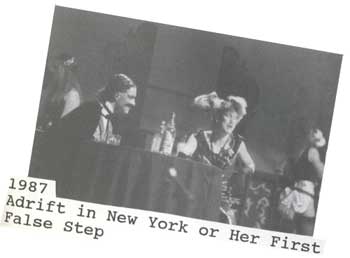
The School produces some memorable, and highly praised, theatre during the
seventies. The plays included Richard III, Princess Ida, Romeo & Juliet,
Orpheus in the Underworld, Under Milkwood, My Fair Lady, Wizard of Oz,
and Sweeney Todd.
Regular school trips became established during these years, including
Form IV skiing trips to Falls Creek, and the Form I orientation trip to
Anglesea. First form Collingwood High School students visited EHS, and
the interschool sports trips between Albury High and Eltham High continued
until 1975.
Larry Fraim, a P.E. teacher from the U.S., not only contributed significantly
to the average fitness of the school, but redefined certain mathematical concepts
at the same time. Who can think back to those sit-ups and star jumps without
remembering the alternative set of positive integers 1, 2, 3, 2, 2, 3, 3,
2, 3, 4, 2 ... bellowed in a loud American accent? The mental struggle required
to follow this sequence of numbers was sufficient to mask the physical pain
induced by the exercise.
Dr. Michael Biggar